How Bugattis Quad-Turbo Technology Evolved Over Decades
Bugatti quad-turbo technology has transformed the hypercar landscape over the past two decades. The system started with the Veyron and reached new heights with the Chiron and Bolide. This evolution shows how four turbochargers deliver insane power while keeping the engine cool and responsive.
Bugatti quad-turbo technology has always been the secret behind the world’s most powerful cars. The idea of using four turbochargers might sound complex, but it’s actually a clever way to keep the engine breathing. When Bugatti first introduced this system in the Veyron, it changed the supercar world forever. Today, the same basic idea powers the Chiron and Bolide. In this article, we’ll explore how Bugatti quad-turbo technology evolved over decades. You’ll learn about the engineering, the challenges, and the future.
Bugatti didn’t invent the turbocharger, but they did perfect a special setup. A quad-turbo system uses four smaller turbochargers instead of one large one. This approach reduces the lag that often hits big turbos. The result is a smooth, endless wave of power. Over the years, Bugatti has tweaked every part of this system. They’ve improved the turbos, the engine layout, and the cooling. Each new model brought fresh ideas. Let’s dive into the story of this amazing technology.
Key Takeaways
- The Veyron introduced quad-turbo W16 engines to the world, proving that forced induction could work at extreme levels.
- The Chiron refined the system with twin-scroll turbochargers, reducing lag and boosting throttle response.
- Quad-turbo setups use a clever layout to feed air evenly to all cylinders, maximizing horsepower and torque.
- Advanced intercooling and aerodynamic cooling channels keep temperatures in check during high-speed runs.
- Bugatti’s engineering influenced the entire hypercar industry, setting new standards for power and reliability.
- Future systems may combine quad-turbo tech with hybrid motors for even greater performance gains.
📑 Table of Contents
- The Veyron: Where Bugatti Quad-Turbo Technology Was Born
- The Chiron: Refining the Bugatti Quad-Turbo Formula
- How Bugatti Quad-Turbo Technology Actually Works
- Aerodynamics and Cooling: Supporting the Bugatti Quad-Turbo System
- The Bolide: Taking Bugatti Quad-Turbo Technology to the Extreme
- The Future of Bugatti Quad-Turbo Technology
- The Lasting Legacy of Bugatti Quad-Turbo Technology
The Veyron: Where Bugatti Quad-Turbo Technology Was Born
The Bugatti Veyron 16.4 arrived in 2005 as a true engineering marvel. It was the first production car to use a quad-turbo W16 engine. The engine combined two narrow-angle VR8 banks into a single W shape. Four turbochargers fed this monster engine with compressed air. The result was 1,001 horsepower and a top speed of 253 mph. At the time, no other car could touch those numbers.
Engineers faced huge challenges. The turbochargers had to be small enough to fit inside the engine bay. They also had to spool up quickly to avoid turbo lag. Bugatti solved this by using a complex intake manifold. The manifold split the airflow evenly to all eight cylinders on each side. This kept the engine running smoothly at any RPM. The Veyron proved that quad-turbo technology could work in a road car. It set the stage for everything that followed.
A 1,001-Horsepower Dream
The Veyron’s target was clear: build the fastest, most powerful production car. To reach 1,001 horsepower, Bugatti needed massive airflow. Four turbochargers made that possible. Each turbo was roughly the size of a small watermelon. They spun up to 200,000 RPM. The engine also used a dry sump lubrication system. This kept oil flowing even under extreme g-forces. The Veyron wasn’t just fast; it was a complete package of luxury and performance.
The W16 Engine Layout
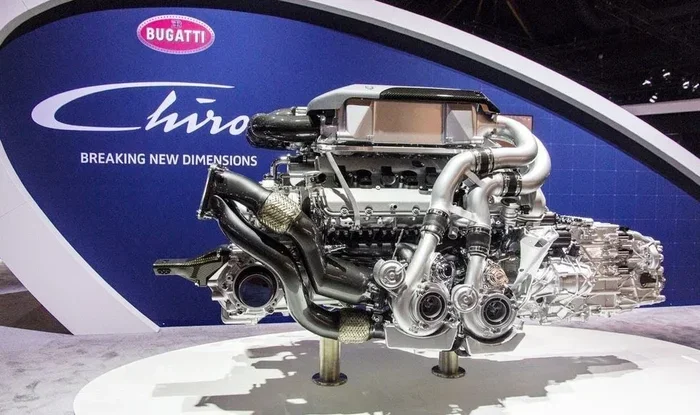
The W16 engine is the heart of Bugatti quad-turbo technology. It has 16 cylinders arranged in a W shape. Two cylinder banks sit at a 72-degree angle. Each bank has four cylinders. The four turbochargers sit between the banks. This compact layout saved space and reduced the car’s center of gravity. The engine displaced 8.0 liters. It used direct fuel injection and four valves per cylinder. This design allowed the engine to rev high and produce huge torque. The Veyron’s W16 remains one of the most complex engines ever built.
The Chiron: Refining the Bugatti Quad-Turbo Formula
The Bugatti Chiron arrived in 2016 as the successor to the Veyron. It kept the same W16 engine concept but made it better. The main focus was on improving the quad-turbo system. Engineers wanted more power and faster response. They also aimed for smoother delivery. The Chiron’s quad-turbo setup delivered 1,479 horsepower. That was a 47% increase over the Veyron. Yet the car felt more refined and usable every day.
Bugatti made several key changes to the turbochargers. They switched to twin-scroll designs for each pair of turbos. Twin-scroll turbos use divided exhaust paths. This helps the turbos spool faster and reduces overlap. The result is a sharper throttle response. The Chiron also used a new intake manifold with larger intercoolers. These changes let the engine breathe more efficiently. The quad-turbo system became even more reliable and consistent.
More Power with Better Turbos
The Chiron’s turbochargers were slightly larger than the Veyron’s. They also used advanced materials like titanium aluminide for the turbine wheels. These wheels are lighter and can spin faster. That means less delay when you hit the throttle. The engine’s peak torque arrived at just 2,000 RPM. It stayed flat all the way to 6,000 RPM. This massive torque band is a direct result of the refined quad-turbo layout. Drivers felt immediate power in any gear.
Twin-Scroll Turbochargers and Response
Twin-scroll technology was a game-changer for Bugatti quad-turbo technology. In a traditional turbo, exhaust pulses can interfere with each other. Twin-scroll separates the exhaust pulses into two channels. This keeps the energy focused and efficient. Each pair of cylinders shares a scroll. The design reduces turbo lag and improves efficiency. Bugatti also added a new electronic wastegate system. This allowed precise control over boost pressure. The system could adjust boost in milliseconds. That made the Chiron feel incredibly responsive.
How Bugatti Quad-Turbo Technology Actually Works
Understanding how quad-turbo systems work helps you appreciate the engineering. At its core, a turbocharger uses exhaust gases to spin a compressor. The compressor pushes more air into the engine. More air means more fuel can be burned. This creates more power. A single turbo can struggle at low RPMs. That’s where the quad-turbo layout shines.
Bugatti’s system uses four small turbochargers. Two turbos handle the front cylinders. Two turbos handle the rear cylinders. The engine control unit (ECU) manages the boost for each turbo. At low speeds, only one turbo per bank might be active. This keeps response quick. As RPMs rise, the other turbos join in. The system seamlessly blends power from all four. The driver feels a smooth, uninterrupted surge of acceleration.
The Basics of Forced Induction
Forced induction is the process of pushing extra air into the engine. A turbocharger is a type of forced induction. It uses exhaust energy to compress intake air. Compressed air is denser. It carries more oxygen molecules. The engine can burn more fuel with that oxygen. More fuel burned means more power. The quad-turbo setup uses four compressors to feed the engine. This ensures every cylinder gets an equal share of air. The result is balanced power delivery and incredible performance.
Why Four Turbos Instead of One Big Turbo?
A single large turbo has a problem: inertia. The large turbine wheel takes time to spin up. This causes turbo lag. Four small turbos have much less inertia. They can reach full boost very quickly. Bugatti’s quad-turbo system also reduces heat buildup. Smaller turbos run cooler than one massive unit. The system also allows for better packaging. The turbos fit neatly between the engine banks. This keeps the overall engine compact. The layout also improves exhaust scavenging. Each turbo handles a specific set of cylinders. This reduces interference and improves efficiency.
Aerodynamics and Cooling: Supporting the Bugatti Quad-Turbo System
Generating massive power creates a lot of heat. The quad-turbo system needs excellent cooling to work reliably. Bugatti spent years perfecting the thermal management. The Chiron and Bolide use advanced air channels and radiators. The goal is to keep the intercoolers and engine at the right temperature. Without proper cooling, the turbos would overheat and lose power.
The Chiron features a large front grille and underbody vents. These channels funnel air directly to the intercoolers. The intercoolers cool the compressed air before it enters the engine. Cooler air is denser and carries more oxygen. This boosts power and prevents detonation. The engine oil and water cooling systems are also highly sophisticated. They use heat exchangers that can handle extreme loads. All of this engineering supports the quad-turbo setup and keeps it running strong.
Managing Extreme Heat
At top speeds, the Chiron generates enormous heat. The brakes can reach over 1,000 degrees Celsius. The engine and turbos also run very hot. Bugatti uses a dedicated cooling circuit for the turbos. This circuit keeps the turbo housing at a stable temperature. It also prevents heat soak, which can reduce boost. The intercoolers are water-to-air type. They use a separate coolant loop. This allows for maximum cooling efficiency. The system can keep intake air temperatures low even on a hot day.
The Intercooler’s Role
The intercooler is a vital part of Bugatti quad-turbo technology. After the turbos compress the air, it becomes very hot. Hot air is less dense, which reduces oxygen content. The intercooler acts like a radiator for the intake air. It passes the hot air through a network of fins and tubes. Ambient air flowing over the intercooler cools it down. The Chiron uses a massive front-mounted intercooler. It also has side-mounted intercoolers for additional capacity. This ensures the air entering the engine is always cool and dense.
The Bolide: Taking Bugatti Quad-Turbo Technology to the Extreme
The Bugatti Bolide is a track-focused hypercar that pushes quad-turbo tech to its limits. It’s not a road car; it’s a pure speed machine. The Bolide uses a modified W16 engine with over 1,800 horsepower. The quad-turbo system was reworked for high-altitude performance. At high speeds, the air density changes. The turbos adjust boost to compensate. The Bolide also uses a new titanium exhaust system. This reduces weight and improves exhaust flow. Every component was optimized for the track.
The Bolide’s aerodynamics are also incredible. It generates over 2,600 kg of downforce at top speed. This keeps the car planted through fast corners. The cooling system is even more aggressive. Massive ducts channel air to the brakes and engine. The quad-turbo setup works in harmony with all these systems. The result is a car that can lap faster than a Formula 1 car. The Bolide proves that Bugatti quad-turbo technology still has a bright future.
Track-Focused Engineering
The Bolide’s engine management system is highly advanced. It can adjust boost pressure for each turbo independently. This allows for fine-tuned power delivery on different track sections. The system also uses a dual-clutch transmission. Gear changes happen in just 20 milliseconds. The quad-turbo system ensures no power is lost during shifts. The car’s carbon-fibre monocoque is incredibly stiff. This helps the turbos maintain consistent boost under heavy aerodynamic loads.
What the Bolide Teaches Us
The Bolide shows us where quad-turbo technology is heading. It’s not just about top speed anymore. It’s about efficiency and thermal management too. The Bolide uses a more compact turbo layout. The turbos are positioned closer to the engine. This reduces the length of the exhaust pipes. Shorter pipes mean less lag and faster response. The system also uses advanced materials that can withstand higher temperatures. These innovations will likely trickle down to future road cars.
The Future of Bugatti Quad-Turbo Technology
What comes next for Bugatti quad-turbo technology? The automotive world is changing fast. Electrification is the big trend. Many hypercars now use hybrid systems. Bugatti has already hinted at a hybrid future. The company’s parent brand, Volkswagen Group, is investing in electric drivetrains. A hybrid Bugatti could use a quad-turbo engine as a range extender. The turbos would still provide instant torque. The electric motor would fill in any low-end gaps.
Another possibility is fully synthetic fuels. These fuels burn cleaner and can be carbon-neutral. A quad-turbo engine running on synthetic fuel could meet future emissions rules. Bugatti could keep the W16 layout but adapt it. The core quad-turbo concept would remain. It’s a proven way to extract maximum power from a combustion engine. Even in an electric age, that engineering has value.
Hybrid and Electric Possibilities
A hybrid Bugatti would likely use the quad-turbo W16 as a generator. The engine would run at its most efficient RPM. It would charge a high-voltage battery pack. The electric motors would provide additional boost during acceleration. This setup would combine the best of both worlds. Instant electric torque plus the sustained power of quad-turbo forced induction. The system could also recover energy under braking. This would improve overall efficiency and reduce fuel consumption.
What’s Next for Hypercars
Bugatti quad-turbo technology will probably remain the foundation of their hypercars. The W16 engine has a legendary status. Fans and engineers alike love its complexity and sound. Future models might use smaller displacement engines with more turbo support. A 4.0-liter quad-turbo engine could rival the current 8.0-liter. It would be lighter and more efficient. The core principles of forced induction and multi-turbo layouts will stay the same. Bugatti will continue to refine the art of breathing engines.
The Lasting Legacy of Bugatti Quad-Turbo Technology
Bugatti quad-turbo technology has left a mark on the entire automotive industry. It proved that forced induction could deliver both massive power and everyday usability. The Veyron shattered stereotypes about turbo lag. The Chiron showed how to refine the concept. The Bolide pushed the boundaries of what’s possible on a track. Every generation brought new innovations. The quad-turbo W16 engine remains a symbol of engineering excellence.
As the world moves toward electrification, Bugatti’s quad-turbo legacy will live on. The principles of efficient forced induction will apply to future engines. Whether it’s a hybrid W16 or a fully electric hypercar, the lessons learned are invaluable. Bugatti showed the world that four turbochargers can create something truly magical. The evolution of this technology is far from over. It’s an exciting chapter in automotive history that continues to unfold.
Frequently Asked Questions
What is Bugatti quad-turbo technology?
Bugatti quad-turbo technology uses four turbochargers to force extra air into the engine. This allows the W16 engine to produce massive horsepower and torque without significant lag. The system has been a core part of Bugatti’s hypercars since the Veyron.
How does the quad-turbo setup reduce turbo lag?
Using four smaller turbochargers instead of one large one reduces inertia. The smaller wheels spin up much faster, providing quicker boost. Bugatti also uses twin-scroll designs and advanced wastegate control to minimize delay. This keeps the power delivery smooth and immediate.
What makes the Bugatti W16 engine special?
The W16 engine combines two narrow-angle VR8 banks into a single W shape. It uses four turbochargers positioned between the cylinder banks. This layout allows for a compact design, a low center of gravity, and incredible airflow. It’s one of the most complex and powerful production engines ever made.
How does cooling support the quad-turbo system?
The quad-turbo system generates a lot of heat. Bugatti uses large intercoolers, dedicated turbo cooling circuits, and aggressive aerodynamic ducts. These systems keep intake air and engine temperatures in check. Proper cooling ensures the turbos can maintain peak boost without overheating.
Will Bugatti continue to use quad-turbo engines in the future?
Bugatti has hinted at hybrid and synthetic fuel options. The quad-turbo W16 could serve as a range extender or run on carbon-neutral fuel. The core concept of multi-turbo forced induction will likely remain central to their future hypercars, even as electrification advances.
How did the Chiron improve on the Veyron’s quad-turbo system?
The Chiron introduced twin-scroll turbochargers and a refined intake manifold. These changes reduced turbo lag and improved throttle response. The engine also produced significantly more power while maintaining reliability. The quad-turbo system became more efficient and usable for everyday driving.