How Much Horsepower Does a Hellcat Have Under the Hood
The Hellcat delivers massive Hellcat horsepower straight from the factory, making it one of the most powerful muscle cars ever built. With a supercharged HEMI V8 engine, the Hellcat produces between 717 and 807 horsepower depending on the model and year. This guide covers every detail you need to know about Hellcat performance, engine specs, and real-world power output.
There are cars, and then there are Hellcats. When you hear the word Hellcat, you probably think of raw power, thunderous exhaust notes, and the kind of acceleration that pins you to your seat. The Dodge Hellcat has earned a legendary reputation in the muscle car world, and the reason is simple. Hellcat horsepower numbers are absolutely massive.
Whether you are a gearhead who lives and breathes V8 engines or someone just curious about what makes these cars so special, this guide has you covered. We will walk through exactly how much horsepower a Hellcat has, how the engine works, how it compares to rival muscle cars, and what you can expect behind the wheel. By the end, you will understand why the Hellcat continues to turn heads and dominate the horsepower wars.
Key Takeaways
- Massive Power Output: The Hellcat produces 717 to 807 horsepower depending on the trim and model year.
- Supercharged HEMI V8: A 6.2-liter supercharged HEMI engine sits under the hood, delivering incredible torque and acceleration.
- Multiple Models Available: The Charger Hellcat, Challenger Hellcat, and Super Stock versions each offer different power levels.
- Real-World Performance: Hellcat cars can hit quarter-mile times under 11 seconds with stock tuning.
- Easy to Drive: Despite the raw power, modern Hellcat models come with advanced stability and traction controls.
- Strong Resale Value: The Hellcat remains one of the most sought-after muscle cars on the used market.
📑 Table of Contents
How Much Horsepower Does a Hellcat Have?
The short answer is that Hellcat horsepower ranges from 717 to 807 horsepower depending on the specific model and year. But the full story is much more interesting than a single number. Let us break it down by model and generation so you can see exactly what each version brings to the table.
Standard Hellcat Output
The base Hellcat model uses a 6.2-liter supercharged HEMI V8 engine. This powerhouse generates 717 horsepower and 650 pound-feet of torque. That is enough to launch the car from zero to sixty in about 3.5 seconds. The engine sits in a front-engine, rear-drive layout that sends all that power to the rear wheels through an eight-speed automatic transmission.
For most drivers, 717 horsepower is more than enough. You get brutal acceleration, highway cruising ability, and enough grunt to handle any road trip or track day. The base Hellcat proves that you do not need to go to the extreme end of the power scale to have a thrilling driving experience.
Hellcat Widebody and Redeye Variants
Dodge did not stop at the base number. The Hellcat Widebody adds wider wheels and tires, which improves grip and handling. Power output stays the same at 717 horsepower, but the car feels much more planted at high speeds. The wider stance makes a real difference when you are pushing the car hard on a track or through tight corners.
The Hellcat Redeye takes things up a notch. This version produces 797 horsepower and 707 pound-feet of torque. The Redeye achieves this through a more efficient supercharger design and upgraded internals. Zero to sixty drops to around 3.3 seconds, and the quarter-mile time comes in under 11 seconds. The Redeye is the sweet spot for enthusiasts who want serious power without stepping up to the extreme Super Stock model.
The Super Stock and Demons
At the top of the Hellcat power hierarchy sits the Super Stock, which pushes 807 horsepower and 717 pound-feet of torque. This is the most powerful production Hellcat ever made. The Super Stock uses the same 6.2-liter supercharged HEMI engine but with upgraded components, a more aggressive supercharger, and special tuning that extracts every last drop of power.
Before the Super Stock, there was the Dodge Demon. The Demon was a limited-edition drag strip weapon that produced 840 horsepower on high-octane fuel. While the Demon is no longer in production, it set the standard for what a factory muscle car could do. The Super Stock carries on that legacy with its incredible power numbers.
What Makes the Hellcat Engine So Powerful?
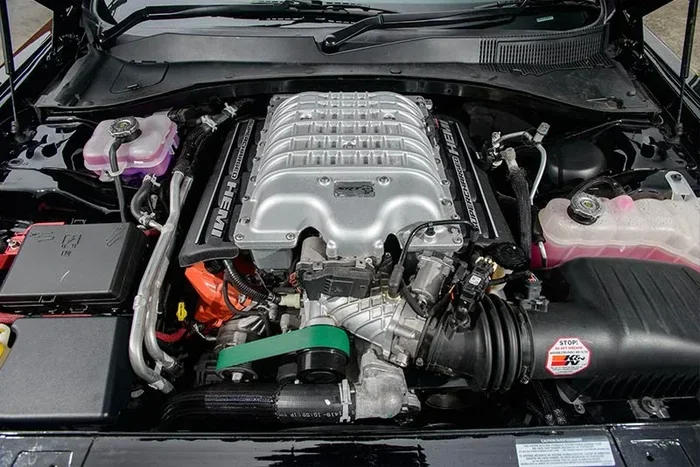
Under the hood of every Hellcat beats a 6.2-liter supercharged HEMI V8 engine. This engine has become iconic in the automotive world, and for good reason. Let us look at the key components that make this engine produce so much Hellcat horsepower.
The Supercharger System
The supercharger is the heart of the Hellcat’s power story. A positive-displacement supercharger sits on top of the engine and forces more air into the combustion chambers. More air means more fuel can be burned, which equals more power. The Hellcat uses a twin-vortices supercharger that spins at high speeds to deliver a massive boost of air pressure.
This supercharger design is different from the turbochargers used in many modern performance cars. A supercharger is driven directly by the engine, which means there is no lag. When you stomp the throttle, the power comes on immediately. That instant response is a huge part of what makes the Hellcat feel so explosive.
Engine Displacement and Design
The 6.2-liter displacement is large by modern standards. Bigger displacement means more air and fuel can be ingested per combustion cycle, which directly translates to more horsepower. The HEMI cylinder head design features a hemispherical combustion chamber, which promotes better airflow and more efficient combustion.
Inside the engine block, you will find forged internals that can handle the extreme pressures of forced induction. The crankshaft, connecting rods, and pistons are all built for durability. This means the Hellcat engine can reliably produce its rated horsepower for years with proper maintenance.
Fuel System and Tuning
The Hellcat uses a high-pressure fuel system with multiple injectors per cylinder. This ensures that the engine receives the right amount of fuel at all times, even under heavy boost. The engine control module (ECM) constantly monitors sensors and adjusts fuel delivery, ignition timing, and boost pressure to maximize performance while protecting the engine.
Dodge tunes each Hellcat variant differently to hit specific power targets. The differences between the base Hellcat, the Redeye, and the Super Stock come down to supercharger boost levels, fuel calibration, and internal engine components. These tuning changes are what allow the same basic engine architecture to produce such a wide range of power output.
Expert Insight
Engineers at Dodge focused on making the Hellcat drivable for everyday use, not just track days. The supercharger boost levels are carefully calibrated to deliver smooth power across the entire RPM range. This is why the Hellcat feels so usable on the street despite having over 700 horsepower.
Hellcat vs. Other Muscle Cars: A Power Comparison
The Hellcat does not exist in a vacuum. It is part of a long tradition of American muscle cars, and it faces stiff competition from Ford, Chevrolet, and other brands. Let us see how Hellcat horsepower stacks up against the rivals.
Hellcat vs. Chevrolet Camaro ZL1
The Camaro ZL1 uses a 6.2-liter supercharged V8 that produces 650 horsepower. That is 67 horsepower less than the base Hellcat. The Camaro ZL1 is a great car, but on paper, the Hellcat has the clear advantage in straight-line power. The Camaro does offer a lighter curb weight, which helps with handling and agility.
Hellcat vs. Ford Mustang GT500
The Ford Mustang GT500 produces 760 horsepower from its 5.2-liter supercharged V8. This puts it close to the Hellcat Redeye in terms of raw power. The GT500 uses a dual-clutch transmission, which shifts faster than the Hellcat’s automatic. However, the Hellcat offers more torque and a more comfortable ride for daily driving.
Hellcat vs. Chevrolet Corvette
The mid-engine Corvette Stingray produces 495 horsepower from its naturally aspirated V8. The difference is enormous. However, the Corvette’s lighter weight and advanced aerodynamics mean it can match or beat the Hellcat on many tracks. The Hellcat wins in straight-line acceleration and top-end speed.
| Model | Engine | Horsepower | Torque (lb-ft) | 0-60 mph |
|---|---|---|---|---|
| Dodge Challenger Hellcat | 6.2L Supercharged V8 | 717 hp | 650 | 3.5 sec |
| Dodge Challenger Hellcat Redeye | 6.2L Supercharged V8 | 797 hp | 707 | 3.3 sec |
| Dodge Challenger Super Stock | 6.2L Supercharged V8 | 807 hp | 717 | 3.1 sec |
| Chevrolet Camaro ZL1 | 6.2L Supercharged V8 | 650 hp | 650 | 3.5 sec |
| Ford Mustang GT500 | 5.2L Supercharged V8 | 760 hp | 625 | 3.3 sec |
| Chevrolet Corvette Stingray | 6.2L Naturally Aspirated V8 | 495 hp | 470 | 2.9 sec |
As you can see from the table, Hellcat horsepower numbers are among the highest in the muscle car segment. The Super Stock leads the pack with 807 horsepower, while even the base Hellcat beats most competitors. This power advantage is a big part of why the Hellcat has remained so popular for so long.
Real-World Performance: What to Expect Behind the Wheel
Numbers on paper are one thing, but how does a Hellcat actually feel and perform in real life? Let us talk about the driving experience and what you can expect when you twist the throttle on a Hellcat.
Acceleration and Throttle Response
The first thing you notice when you launch a Hellcat is the immediate surge of power. The supercharger fills the cabin with a deep, aggressive roar as boost builds. The acceleration is violent but surprisingly controllable thanks to advanced traction control systems. Even in automatic mode, the Hellcat launches hard and stays planted.
In manual mode (available on some models), you get even more control over gear changes. The eight-speed automatic transmission shifts quickly and intelligently, holding lower gears when you need full power and upshifting for highway cruising. The result is a car that feels fast in every gear.
Handling and Braking
With all that Hellcat horsepower, you need a car that can stop and turn too. The Hellcat comes with Brembo brakes as standard on most trims, which provide excellent stopping power even during repeated hard stops. The suspension is tuned for a balance of comfort and performance, making the Hellcat surprisingly livable as a daily driver.
Handling is where the Hellcat shows its muscle car roots. It is a big, heavy car, so it does not feel as nimble as a mid-engine Corvette. But the Widebody versions with their wider tires and upgraded suspension do a remarkable job of keeping the car planted through corners. If you are willing to invest in aftermarket suspension upgrades, the Hellcat can handle even harder driving.
Fuel Economy and Daily Driving
Let us be honest. A car with 717 horsepower is not going to win any fuel economy awards. The base Hellcat gets around 13 miles per gallon in the city and 22 miles per gallon on the highway. The Redeye and Super Stock figures are similar or slightly lower. But for most Hellcat owners, fuel economy is a secondary concern.
That said, the Hellcat is surprisingly usable as a daily driver. The ride quality is comfortable, the seats are supportive, and the infotainment system is modern and user-friendly. Dodge designed the Hellcat to be a complete car, not just a drag strip weapon. You can drive it to work, run errands, and still have a blast on the weekend.
Common Mistakes Hellcat Owners Make
If you are thinking about buying a Hellcat or just bought one, here are some common mistakes to avoid. These tips can help you get the most out of your car and keep it running strong for years.
- Skipping the break-in period: The Hellcat engine needs proper break-in to ensure the pistons and rings seat correctly. Follow the manufacturer’s guidelines for the first 1,000 miles.
- Using low-octane fuel in high-performance models: The Redeye and Super Stock require premium fuel. Using regular gas will reduce power and can cause engine knock over time.
- Neglecting oil changes: With a supercharged engine, oil temperatures run higher. Change your oil regularly and use the recommended synthetic oil.
- Ignoring tire maintenance: All that horsepower goes through the tires. Check your tire pressure often and replace worn tires before they become a safety issue.
- Over-revving in cold weather: Cold engines need time to warm up. Let the oil circulate for a minute or two before pushing the car hard.
The Future of Hellcat Horsepower
The automotive industry is shifting toward electrification, and even Dodge has announced plans for electric muscle cars. But the Hellcat remains a beloved icon of the internal combustion era. Here is what you need to know about the future of Hellcat horsepower.
Will There Be a Hellcat 2.0?
Rumors have circulated about a next-generation Hellcat with even more power. Dodge has hinted at continued investment in the HEMI platform, and enthusiasts are hopeful that a new Hellcat could produce over 900 horsepower. While nothing has been officially confirmed, the writing is on the wall that Dodge is not ready to abandon the Hellcat name entirely.
Electric Muscle Cars and the Hellcat Legacy
Dodge has teased an electric muscle car that could carry on the Hellcat spirit in a new form. Electric motors deliver instant torque, which means an electric Hellcat could potentially outperform current models in acceleration. However, the visceral experience of a supercharged V8 is something that electric cars have yet to replicate fully.
For now, the Hellcat stands as the pinnacle of the supercharged muscle car era. Each new model year brings slight refinements, but the core formula remains the same. A big-displacement V8 with a supercharger delivering massive Hellcat horsepower to the rear wheels. That formula has proven incredibly popular, and it will be missed when it finally goes away.
Is a Hellcat Right for You?
Buying a Hellcat is a big decision. The car is fast, powerful, and expensive to own. Before you pull the trigger, consider these factors.
- Budget: Hellcats hold their value well, but they are still a significant investment. Insurance costs are higher than average due to the high power output and performance nature of the car.
- Driving needs: If you need a practical daily driver for commuting and errands, a Hellcat might be overkill. But if you want a car that can do everything and dominate on the weekend, it is hard to beat.
- Maintenance costs: Parts for the Hellcat are not cheap, and the car requires regular maintenance to keep it running at its best. Factor in higher-than-average service costs when budgeting.
- Community and culture: The Hellcat community is one of the most passionate in the automotive world. Owners share mods, track days, and road trips. If you love car culture, owning a Hellcat connects you to a vibrant community.
At the end of the day, the Hellcat is about more than just numbers. It is about the experience. It is about the sound of that supercharged HEMI firing up, the feeling of acceleration pressing you back into your seat, and the smiles you get every time you twist the key. Hellcat horsepower is incredible, but the experience it delivers is what truly sets this car apart.
Conclusion
So, how much horsepower does a Hellcat have under the hood? The answer depends on the model, but the range is 717 to 807 horsepower for current production models, with legendary variants like the Demon pushing beyond 840 horsepower. The Hellcat horsepower numbers are among the highest ever produced by a factory American muscle car, and they continue to impress enthusiasts and critics alike.
The supercharged 6.2-liter HEMI V8 engine is the heart of the Hellcat, and it has proven itself as one of the most impressive powerplants in automotive history. Whether you choose the base Hellcat, the Redeye, or the Super Stock, you are getting a car that delivers incredible performance and unforgettable driving experiences.
If you have been on the fence about the Hellcat, now is a great time to explore what these machines have to offer. The Hellcat represents the best of American muscle car engineering, and its legacy will live on for years to come. Hellcat horsepower is not just a number. It is a statement.
Frequently Asked Questions
How much horsepower does a Hellcat have in the 2024 model year?
The 2024 Dodge Challenger Hellcat produces 717 horsepower from its 6.2-liter supercharged HEMI V8 engine. This is the same output as previous model years, with the Redeye and Super Stock variants offering higher numbers of 797 and 807 horsepower respectively.
Can a Hellcat hit 1000 horsepower with stock parts?
No, the factory Hellcat produces between 717 and 807 horsepower depending on the model. Reaching 1000 horsepower requires aftermarket upgrades like a larger supercharger, upgraded fuel system, and engine internals. Many enthusiasts achieve this through careful tuning and parts upgrades.
Is Hellcat horsepower enough to beat a Tesla in a drag race?
In a straight-line drag race, a Hellcat can compete closely with many Tesla models. Tesla’s instant electric torque gives it an advantage off the line, but the Hellcat’s massive horsepower and top-end speed can close the gap or win at higher speeds depending on the specific models being compared.
What fuel does a Hellcat need to produce its rated horsepower?
The base Hellcat can run on 87-octane regular fuel, though it is recommended to use premium for best performance. The Hellcat Redeye and Super Stock require premium 91-octane fuel to achieve their full rated horsepower numbers. Using lower-octane fuel in these models will reduce power output.
How does the Hellcat compare to the Dodge Demon in terms of power?
The Dodge Demon was a special edition model that produced 840 horsepower on high-octane fuel, making it more powerful than the Super Stock’s 807 horsepower. The Demon was designed specifically for drag racing with features like drag launch control and lightweight components. It is now a collector’s item since production ended.
Does Hellcat horsepower decrease over time with age?
Like any car, a Hellcat may lose a small amount of horsepower as it ages due to normal wear on engine components, carbon buildup, and sensor degradation. However, with proper maintenance including regular oil changes, spark plug replacements, and air filter changes, a Hellcat can maintain close to its factory horsepower output for many years.