How Long Does a Full Alignment Take at Your Mechanic
A full wheel alignment typically takes between 30 minutes and 2 hours, depending on your vehicle type and the work needed. Most standard passenger cars fall in the 1-hour range, while larger vehicles or those needing suspension repairs may take longer. Understanding what affects the timeline helps you plan your visit and set realistic expectations.
You just pulled into the mechanic’s shop, and the first question on your mind is simple — how long does a full alignment take? Maybe your car is pulling to one side, or your tires are wearing down unevenly. Either way, you need answers fast. You have places to be, and sitting in a waiting room for hours is not on your agenda.
The good news is that most full alignments don’t take all day. A standard wheel alignment for a regular passenger car usually wraps up in about an hour. But several factors can push that time shorter or longer. Your vehicle type, the condition of your suspension, and the specific alignment service you need all play a role.
In this guide, we will walk through everything you need to know about alignment time. We will cover the different types of alignments, what the process looks like step by step, and the factors that can speed things up or slow them down. By the end, you will know exactly what to expect when you pull into the shop.
Let us get into it. No fluff, no filler — just clear, practical information that helps you plan your visit with confidence.
Key Takeaways
- Standard alignments take 30–90 minutes: Most everyday cars and SUVs need about an hour for a complete four-wheel alignment.
- Vehicle type matters a lot: Trucks, luxury cars, and older vehicles often require more time due to access and complexity.
- Suspension issues add time: If worn parts need replacing before alignment, the total visit can stretch to 2–3 hours.
- Two-wheel vs. four-wheel alignment: A front-end alignment is faster, but a full four-wheel job gives better results for most modern vehicles.
- Pre-scheduled appointments save time: Walking in without an appointment can lead to longer wait times and delays.
- Regular alignment checks prevent problems: Staying on top of your alignment schedule keeps tires wearing evenly and your car driving straight.
- Ask your mechanic for a time estimate upfront: Every shop operates differently, so getting a clear timeline before you arrive is smart.
📑 Table of Contents
- What Happens During a Full Alignment
- How Long Does Each Type of Alignment Take
- Factors That Affect Alignment Duration
- Signs Your Vehicle Needs an Alignment
- The Alignment Process Step by Step
- How Often Should You Get a Full Alignment
- How to Save Time at the Alignment Shop
- Common Mistakes That Lead to Repeat Visits
- Final Thoughts
What Happens During a Full Alignment
A full alignment is not just about adjusting your wheels. It is a detailed process that involves measuring and correcting the angles of your tires. These angles — known as camber, caster, and toe — determine how your tires contact the road. When they are off, you get uneven tire wear, poor fuel economy, and a steering wheel that feels off-center.
The Three Key Alignment Angles
Every vehicle alignment job focuses on three main angles. Understanding them helps you appreciate why the process takes the time it does.
- Camber: This is the inward or outward tilt of your tire when viewed from the front. Too much tilt on either side causes rapid tire wear on one edge.
- Caster: This is the angle of your steering axis when viewed from the side. It affects steering stability and cornering control.
- Toe: This refers to how much your tires turn inward or outward when viewed from above. Toe misalignment is one of the most common causes of pulling.
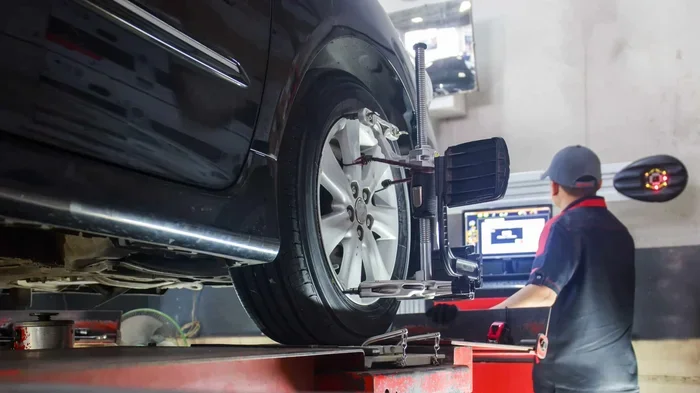
Your mechanic uses a specialized alignment machine to measure each of these angles with extreme precision. The machine attaches sensors to your wheels and feeds data to a computer. From there, the technician compares your readings to the manufacturer’s specifications. Any deviations get corrected one angle at a time.
This level of precision is why a professional alignment cannot be rushed. Accuracy matters more than speed here. Getting it right the first time saves you from coming back in a few weeks with the same problem.
How Long Does Each Type of Alignment Take
Not all alignments are the same. The type of alignment procedure your car needs directly affects how long you will be at the shop. Here is a breakdown of the most common types and their typical time frames.
Front-End Alignment (Two-Wheel)
A front-end alignment, also called a two-wheel alignment, focuses only on the front wheels. This is the quickest option and usually takes about 30 to 45 minutes. It works well for older vehicles with a solid rear axle that does not need adjustment.
However, most modern cars, SUVs, and crossovers come with adjustable rear suspensions. In those cases, a front-end-only alignment may not fully solve your problem. The rear wheels can still be out of spec, which means your tire wear issues and pulling may continue.
Four-Wheel Alignment
A four-wheel alignment is the most comprehensive option and the one most vehicles need today. This process adjusts all four wheels and typically takes between 60 and 90 minutes for a standard passenger car.
During a four-wheel alignment check, the technician adjusts the front camber, caster, and toe, and then moves to the rear wheels. The rear typically gets toe adjustment and sometimes camber as well. This thorough approach ensures all four tires are working together as a team.
Thrust Alignment
A thrust alignment is a middle-ground option. It checks the rear wheels first to make sure they are aligned with the front axle, and then adjusts the front. This usually takes about 45 to 60 minutes. It is a good choice for vehicles with a non-adjustable rear suspension.
Comparison Table: Alignment Types and Time Frames
| Alignment Type | Wheels Adjusted | Typical Time | Best For |
|---|---|---|---|
| Front-End (Two-Wheel) | Front only | 30–45 minutes | Older vehicles with solid rear axles |
| Thrust Alignment | Rear + Front | 45–60 minutes | Vehicles with non-adjustable rear suspension |
| Four-Wheel Alignment | All four wheels | 60–90 minutes | Most modern cars, SUVs, and crossovers |
| Heavy Duty / Truck | All four + suspension | 90 minutes–2 hours | Trucks, SUVs with lift kits, or damaged suspensions |
As you can see, the answer to how long does a full alignment take depends heavily on which type of job your vehicle requires. Always ask your mechanic which type they recommend and why.
Factors That Affect Alignment Duration
Even for the same type of alignment, the time can vary from one car to the next. Several factors come into play. Knowing what they are helps you understand why your alignment service might take a little longer or shorter than average.
Vehicle Type and Make
Your vehicle’s make and model have a big impact on alignment time. A compact sedan with easy access to suspension components usually gets done faster. A full-size truck with a lifted suspension or a luxury SUV packed with electronic sensors can take considerably longer.
Some vehicles have tight engine bays or suspension parts that are hard to reach. Mechanics need extra time to position the alignment machine sensors correctly. Luxury vehicles with advanced suspension alignment systems may require specialized equipment and additional calibration steps.
Condition of Suspension Components
This is one of the biggest wild cards. If your mechanic discovers worn ball joints, bad tie rod ends, or a bent control arm during the alignment check, the job gets more complicated. Those parts need to be replaced before the alignment can be completed properly.
Replacing suspension parts adds 30 minutes to over an hour to the total visit. This is why some alignment shops recommend getting a full inspection before committing to the alignment. It gives you a clearer picture of both the cost and the time involved.
Age of the Vehicle
Older vehicles tend to have more rust and corrosion on suspension bolts and fittings. Removing rusted bolts takes extra time and patience. In some cases, penetrating oil needs to soak for a while before parts can be safely removed and reinstalled.
Newer vehicles, on the other hand, generally go faster. The parts are clean, and the alignment procedure follows straightforward manufacturer specs. However, newer cars with advanced driver-assistance systems may need recalibration after alignment, which adds time.
Shop Equipment and Experience
The quality of the alignment machine matters. A modern, computer-controlled alignment system works faster and more accurately than older models. Experienced technicians also work more efficiently because they know exactly where to look and what to adjust.
Busy shops during peak hours might have a queue. If you walk in without an appointment on a Saturday morning, you could be waiting an extra hour or more just to get started. Scheduling ahead is one of the easiest ways to reduce your total time at the shop.
Signs Your Vehicle Needs an Alignment
Knowing the warning signs of a misaligned vehicle helps you catch problems early. The sooner you address alignment symptoms, the less time the issue has to cause damage to your tires and suspension.
Common Warning Signs
- Your car pulls to one side: This is the most obvious sign. If you take your hands off the steering wheel on a straight road and the vehicle drifts, your alignment is likely off.
- Uneven tire wear: Check your tires regularly. If the inside or outside edge of the tread is wearing down faster than the rest, you have an alignment problem.
- Off-center steering wheel: When driving straight, your steering wheel should sit level and centered. If it is tilted to one side, get a tire alignment check.
- Vibrating steering wheel: While vibrations can have multiple causes, misalignment is a common culprit, especially when combined with other symptoms.
- Squealing tires: Tires that are not properly aligned can squeal during turns because they are scrubbing against the road at the wrong angle.
If you notice any of these signs, do not ignore them. Driving on misaligned wheels may feel like a minor annoyance, but it causes real damage over time. Uneven tire wear means you will need new tires sooner, and that is an expensive fix compared to a simple alignment.
Quick Tip: The Penny Test
Here is a simple trick you can do at home. Grab a penny and insert it into your tire tread with Lincoln’s head pointing down. If you can see the top of his head, your tread is too worn. This usually points to an alignment problem that has been left unchecked for too long.
The Alignment Process Step by Step
Wondering what actually happens when you hand your keys over? Understanding the alignment procedure step by step removes the mystery and helps you feel more comfortable when you are in the shop.
Step 1: Initial Inspection
Your mechanic starts with a visual inspection of your tires, suspension components, and steering linkage. They look for worn parts, leaks, and obvious damage. This step usually takes about 10 to 15 minutes.
Step 2: Mounting the Sensors
Next, the technician mounts clamps with sensors on each wheel. These sensors connect to a computer that communicates with the alignment machine. The car is then placed on a level lift platform. This setup typically takes 10 to 15 minutes.
Step 3: Measuring Current Angles
With the sensors in place, the computer reads the current camber, caster, and toe angles on all wheels. The technician turns the steering wheel through various positions to capture full data. This measurement phase takes about 10 minutes.
Step 4: Making Adjustments
Now comes the core of the alignment service. The technician adjusts each angle to match the manufacturer’s specifications. They work through the front wheels first, then the rear. Depending on the vehicle, this step takes 30 to 60 minutes.
Step 5: Final Verification
After adjustments, the technician runs a final scan to confirm all angles are within spec. They also test drive the vehicle briefly to make sure the steering feels right and the car tracks straight. This verification step takes about 10 to 15 minutes.
Step 6: Clean Up and Paperwork
The last step is cleaning up, removing the sensors, and providing you with a printout of the before-and-after measurements. This wraps up the visit in about 5 to 10 minutes.
When you add all these steps together, a straightforward four-wheel alignment for a standard car lands right around the 60-minute mark. More complex jobs naturally take longer.
How Often Should You Get a Full Alignment
Timing matters when it comes to alignment maintenance. Getting your alignment checked too often wastes money. Waiting too long risks damaging your tires and suspension.
General Guidelines
Most experts recommend getting a full alignment every 6,000 to 12,000 miles. A good rule of thumb is to have it checked every time you get your oil changed. Many alignment shops offer a quick complimentary check during routine service visits.
You should also get an alignment after any of the following events:
- Hitting a large pothole or curb
- Being involved in a minor accident
- Replacing suspension or steering components
- Installing new tires
- Noticing any of the warning signs listed earlier
Staying proactive with your alignment schedule is one of the easiest ways to extend the life of your tires and keep your car driving safely. A little prevention goes a long way toward avoiding costly repairs down the road.
Expert Insight: The Cost of Ignoring Alignment
Here is something many drivers do not think about. Ignoring a misalignment does not just affect your steering. It directly impacts your wallet. Uneven tire wear can reduce the life of a set of tires by 25 to 50 percent. That means you are replacing tires years earlier than you should. A single alignment costs a fraction of what a new set of tires costs. The math is simple — stay on top of your alignment.
How to Save Time at the Alignment Shop
You cannot always control how long the alignment procedure takes, but you can control a few things that help speed things up.
Tips to Reduce Your Wait Time
- Call ahead and schedule an appointment. This is the single best thing you can do. Most shops can slot you in within a day or two.
- Ask about a pre-inspection. Some shops will inspect your suspension over the phone or via photos. This helps them prepare the right parts and tools before you arrive.
- Bring your vehicle manual. If you have it, the technician can quickly reference the manufacturer’s alignment specs without looking them up.
- Choose a less busy time. Weekday mornings are typically the slowest periods at most alignment shops.
- Ask for a time estimate upfront. A good shop will give you a clear timeline before they start working on your car.
These small steps add up. You walk in prepared, the team knows what they are working with, and your alignment service moves along smoothly.
Common Mistakes That Lead to Repeat Visits
Nobody wants to go back to the shop for the same alignment issue. Here are some common mistakes that lead to repeat visits and how to avoid them.
- Skipping the suspension inspection: If a worn part is causing the misalignment, adjusting the angles without fixing the root cause is a waste of time. Always insist on a full inspection.
- Choosing the cheapest shop: Budget shops sometimes use outdated equipment or rush through the job. A quality alignment machine and a skilled technician are worth the investment.
- Not asking for a printout: A reputable shop will give you before-and-after readings. This documentation proves the work was done correctly and gives you a baseline for future checks.
- Driving habits after alignment: Avoid hitting potholes and curbs immediately after your alignment. Give your new settings time to settle and your tires time to adjust.
Avoiding these mistakes helps you get the most out of every alignment visit. It also means less wasted time and money in the long run.
Final Thoughts
So, how long does a full alignment take at your mechanic? For most standard vehicles, you are looking at about an hour for a complete four-wheel alignment. Simple front-end jobs can be done in under 45 minutes, while complex jobs involving suspension repairs may stretch to two hours or more.
The key takeaway is that there is no single answer. Your alignment time depends on your vehicle, the type of alignment, the condition of your suspension, and the shop you choose. But with the right preparation and realistic expectations, your visit should be quick, efficient, and well worth the investment.
Take care of your alignment regularly, watch for the warning signs, and build a relationship with a trusted alignment shop. Your tires — and your wallet — will thank you for it. A well-aligned vehicle drives better, lasts longer, and keeps you safer on the road. That is time well spent.
Frequently Asked Questions
Can I drive my car immediately after a full alignment?
Yes, in most cases you can drive right away. A full alignment does not require any curing or settling time. However, it is a good idea to drive gently for the first few miles and avoid rough roads. This gives your new settings a chance to stabilize and your tires a chance to adjust to their new positions.
Is a front-end alignment the same as a full alignment?
No, they are different. A front-end alignment only adjusts the front two wheels. A full alignment, also called a four-wheel alignment, adjusts all four wheels. Most modern vehicles benefit from a full alignment because their rear suspensions are adjustable. Ask your mechanic which type your vehicle needs.
Does a full alignment fix a vibrating steering wheel?
Not always. While misalignment can cause vibrations, a vibrating steering wheel can also be caused by unbalanced tires, worn suspension parts, or warped brake rotors. If you still feel vibrations after an alignment, let your mechanic know so they can investigate other possible causes.
How much does a full alignment cost?
The cost varies depending on the type of alignment and your vehicle. A standard four-wheel alignment typically costs between $75 and $200. Luxury vehicles, trucks with lifted suspensions, or jobs that require additional suspension repairs may cost more. Always ask for a detailed estimate before the work begins.
Can I get an alignment with a bad suspension?
You can, but it is not recommended. Worn or damaged suspension parts will prevent the alignment from holding. Mechanics usually recommend replacing the damaged components first, and then performing the alignment. This ensures the adjustments last and your tires wear evenly.
Will a new alignment fix my car pulling to one side?
In most cases, yes. A car pulling to one side is one of the most common symptoms of misalignment. After a proper four-wheel alignment, your vehicle should track straight and the steering wheel should sit level. If the pulling continues, there may be other issues such as brake problems or tire pressure differences that need to be addressed.